Searching Deeper
After having found the initialled work and the other essays obviously by Wedgwood, how to find more?
I searched the digitised content of the Spectator archive for her signature words/concepts/metaphors:
refraction
dislocation
misconception
recollection
arduous
oscillation
antithesis
confute
watershed
recoil from
parallax
Antithesis and recoil from were the most fruitful and you can almost use a search for these to pick out most of her writings.
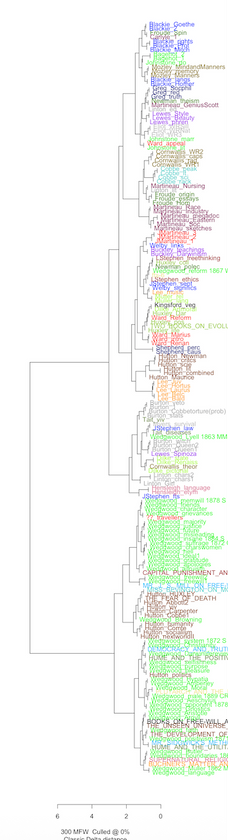
I also made use of the corpus analysis software Stylo in RStudio.comparing the relative frequency with which texts in the corpus use the top 300 most common words in the total pool: words like ‘the’, ‘this’, ‘of’, ‘which’, etc. (or one can use the top 100, top 500, etc.) There are telltale variations in how often different authors use each ‘MFW’ (most frequent word). On this basis, the texts are sorted into clusters. An illustration is below. It is not perfect and only probabilistic. BUT if it highlights something is by Wedgwood, that is good reason to look more closely.
‘Recoil from’ is rare. One only has to glance over sixty items, starting from 1828 when the Victorian-age Spectator was founded, to reach the first piece I can definitely identify as Wedgwood’s – and remember, this is a journal that appeared weekly, year on year, with over fifty items per issue.
‘Watershed’ is even rarer: Wedgwood essays using it appear after only thirty items in the search, again beginning in 1828. Plus, almost all those predecessors are travel writings that mention literal watersheds.
The more of her signature words combine in a particular essay, the stronger the signal it is hers.
Stylo diagram:
Note: to produce these diagrams, you have to get a big mass of texts and convert them using Optical Character Recognition to plain text format. Then you can run Stylo on them.
There's no confirmation basis - it sorts them by similarity of MFWs, not which author you have listed the piece under.
Here you can see it places most of Wedgwood's work closest to Hutton's but largely on its own branch of the tree.